

You check your engine oil, rotate your tires, and maybe even keep an eye on your coolant. But there’s one critical, life-saving fluid that often languishes in neglect at the back of the engine bay: your brake fluid. For the vast majority of modern vehicles, that fluid is DOT 4. It’s the silent hero of your vehicle’s safety system, and understanding it is non-negotiable for any responsible car owner. This comprehensive guide will demystify DOT 4 brake fluid, explain its vital function, and give you a clear, actionable timeline for when to change it. We’ll also highlight why choosing a high-quality product from a trusted brand like Nescol Lubricants is one of the smartest investments you can make in your vehicle’s safety.
What Exactly is Brake Fluid? The Hydraulic Heart of Your Brakes
Before we dive into the specifics of best brake fluid dot 4 UAE, let’s cover the basics. Your car’s braking system is a hydraulic system. This means it uses a fluid to transfer force.
Here’s the simple sequence of events when you press the brake pedal:
You apply pressure to the brake pedal.
This force is transferred to a piston in the master cylinder.
The piston pushes the brake fluid through a network of sealed brake lines and hoses.
The fluid’s pressure forces the brake calipers (or wheel cylinders in drum brakes) to clamp the brake pads onto the rotors, creating friction.
This friction slows down and stops your car.
Without brake fluid, this entire system fails. It is the indispensable link between your foot and the brakes at each wheel. The key property that makes this work is that fluids are largely incompressible, allowing for the efficient and immediate transfer of force.
DOT 4 Brake Fluid: A Deeper Dive into its Composition and Standards
The “DOT” stands for Department of Transportation, which sets the minimum performance standards for brake fluids. DOT 4 is one of the most common specifications globally. So, what makes it special?
Chemical Base: Dot 4 brake fluids is typically a glycol-ether based fluid. This formulation is designed to meet specific, stringent requirements.
The Two Critical Boiling Points: This is where DOT 4 truly shines.
Dry Boiling Point: This is the boiling point of fresh, new, moisture-free fluid. For DOT 4, this is typically ≥ 230°C (446°F).
Wet Boiling Point (ERBP – Equilibrium Reflux Boiling Point): This is the boiling point after the fluid has absorbed a certain amount of moisture (about 3.7%). For DOT 4, this must be ≥ 155°C (311°F).
Why do these boiling points matter? If the fluid boils, it turns into vapor. Unlike liquid, vapor is compressible. This leads to a spongy brake pedal and a complete loss of braking power, a terrifying phenomenon known as “brake fade.” This is most likely to occur under heavy, repeated braking, such as when driving down a steep mountain pass or during aggressive track driving.
The Invisible Enemy: Why Brake Fluid Degrades and Absorbs Moisture
Brake fluid is hygroscopic—meaning it actively absorbs moisture from the air. This happens through microscopic pores in rubber hoses and even through the vented cap of the master cylinder reservoir. This is not a design flaw; it’s intentional. By absorbing water, the fluid prevents it from pooling elsewhere in the system and causing localized corrosion.
However, this hygroscopic nature is the primary reason brake fluid must be changed. Over time, as more moisture is absorbed, three major problems occur:
- Lowered Boiling Point: As we saw with the “wet” boiling point, even a small amount of water dramatically reduces the fluid’s tolerance for heat. Your safe, high-temperature fluid gradually becomes a risky, low-temperature one.
- Internal Corrosion: The water in the fluid leads to rust and corrosion inside the master cylinder, brake lines, calipers, and ABS modulators. This corrosion can cause pistons to stick, seals to fail, and tiny particles to clog the system.
- Reduced Performance in Cold Weather: In freezing temperatures, the absorbed water can turn to ice, potentially blocking brake lines and causing a failure.
This degradation is inevitable and happens regardless of mileage. This is why time-based intervals are just as important as mileage-based ones.
The Critical Question: When Should You Change Your DOT 4 Brake Fluid?
So, when is the right time? The answer isn’t always a single, simple number, but here are the definitive guidelines.
1. Follow Your Vehicle Manufacturer’s Recommendation
This is your first and most important resource. Check your owner’s manual. Most manufacturers recommend a change interval of every 2 years or 30,000 to 45,000 miles, whichever comes first. Some performance-oriented brands may suggest an even shorter interval.
2. Look for These Tell-Tale Signs
Even if you’re within the time/mileage window, be alert to these symptoms of degraded fluid:
A Spongy or Soft Brake Pedal: If the pedal sinks closer to the floor than it used to, it’s a classic sign of air or vapor in the system, often caused by boiling, degraded fluid.
The ABS Light Illuminates: Contaminated fluid can cause issues within the intricate valves of the Anti-lock Braking System (ABS), triggering a warning light.
A Strange Brake Pedal Feel: Any mushiness, inconsistency, or a pedal that feels different is a red flag.
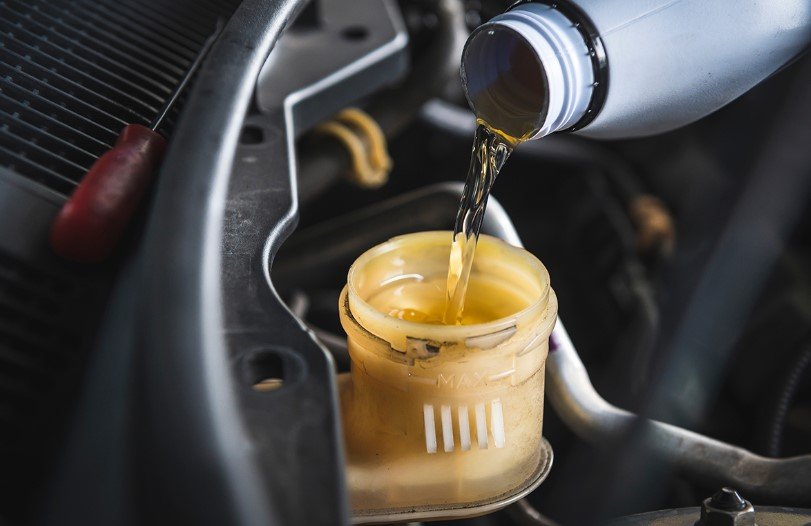
Visible Inspection: Check the fluid in the master cylinder reservoir. New DOT 4 fluid is a clear, slightly amber color. As it ages, it turns dark brown or black. Dark fluid is a sure sign it’s time for a brake fluid flush.
3. The Professional Test: Boiling Point Tester
A professional mechanic—or a well-equipped DIYer—can use a device called a brake fluid tester. This tool measures the water content in the fluid and gives a direct indication of its current boiling point. If the boiling point is approaching the minimum “wet” specification, it’s time for a change. For those who demand precision, this is the gold standard.
Brake Fluid Change Process: Flush vs. Bleeding
It’s crucial to understand the difference between “bleeding” and “flushing” your brakes.
Bleeding the Brakes: This is the process of removing air from the system. It involves pushing a small amount of fluid through each brake caliper’s bleeder valve. This is done when air has entered the system, for example, after replacing a caliper or hose.
Flushing the Brakes: This is a complete fluid exchange. The old, contaminated fluid is entirely removed from the system and replaced with new, clean fluid. This is the service that should be performed at regular intervals to maintain system health. A full brake fluid flush ensures that every component, from the master cylinder to the ABS module, is protected by fresh fluid.
Why Your Choice of Brand Matters: The Nescol Lubricants Advantage
Not all Dot4 brake fluid are created equal. While they all must meet the minimum DOT standard, the quality of the base chemicals and additive packages can vary significantly. This is where choosing a reputable brand like Nescol Lubricants makes a tangible difference.
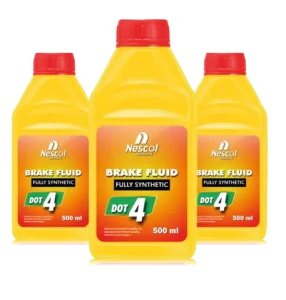
When you choose Nescol Lubricants DOT 4 Brake Fluid, you are investing in:
Superior Corrosion Protection: High-quality additive packages in Nescol Lubricants formulas are designed to actively protect against rust and corrosion in all the critical metal components, extending the life of your expensive calipers and master cylinder.
Consistent High Performance: A higher and more stable boiling point, even over time, provides a greater safety margin, especially under demanding driving conditions.
Optimal Viscosity: The fluid is engineered to maintain the correct viscosity across a wide temperature range, ensuring fast and reliable operation of modern ABS and stability control systems.
Compatibility: Nescol Lubricants DOT 4 is compatible with all DOT 3, DOT 4, and DOT 5.1 systems, making it a versatile and safe choice for a wide range of vehicles.
Don’t view brake fluid as a generic commodity. It’s a precision-engineered chemical that stands between you and a hazard. Trusting a brand with a commitment to quality, like Nescol Lubricants, is a simple step with profound implications for safety.
Final Thoughts
Your vehicle’s braking system is a masterpiece of engineering, but its performance is entirely dependent on the quality and condition of a single fluid. DOT 4 brake fluid is a high-performance hydraulic fluid with a finite service life. Adhering to a strict 2-year or 30,000-mile change interval, watching for warning signs, and insisting on a high-quality product are the three pillars of brake system maintenance.
By choosing Nescol Lubricants for your next Brake Fluid Flush, you are not just maintaining your vehicle; you are making a proactive investment in the safety of yourself, your passengers, and everyone else on the road. Don’t wait for a spongy pedal to remind you—check your fluid today and schedule a service if it’s due. Your safety is worth it.